

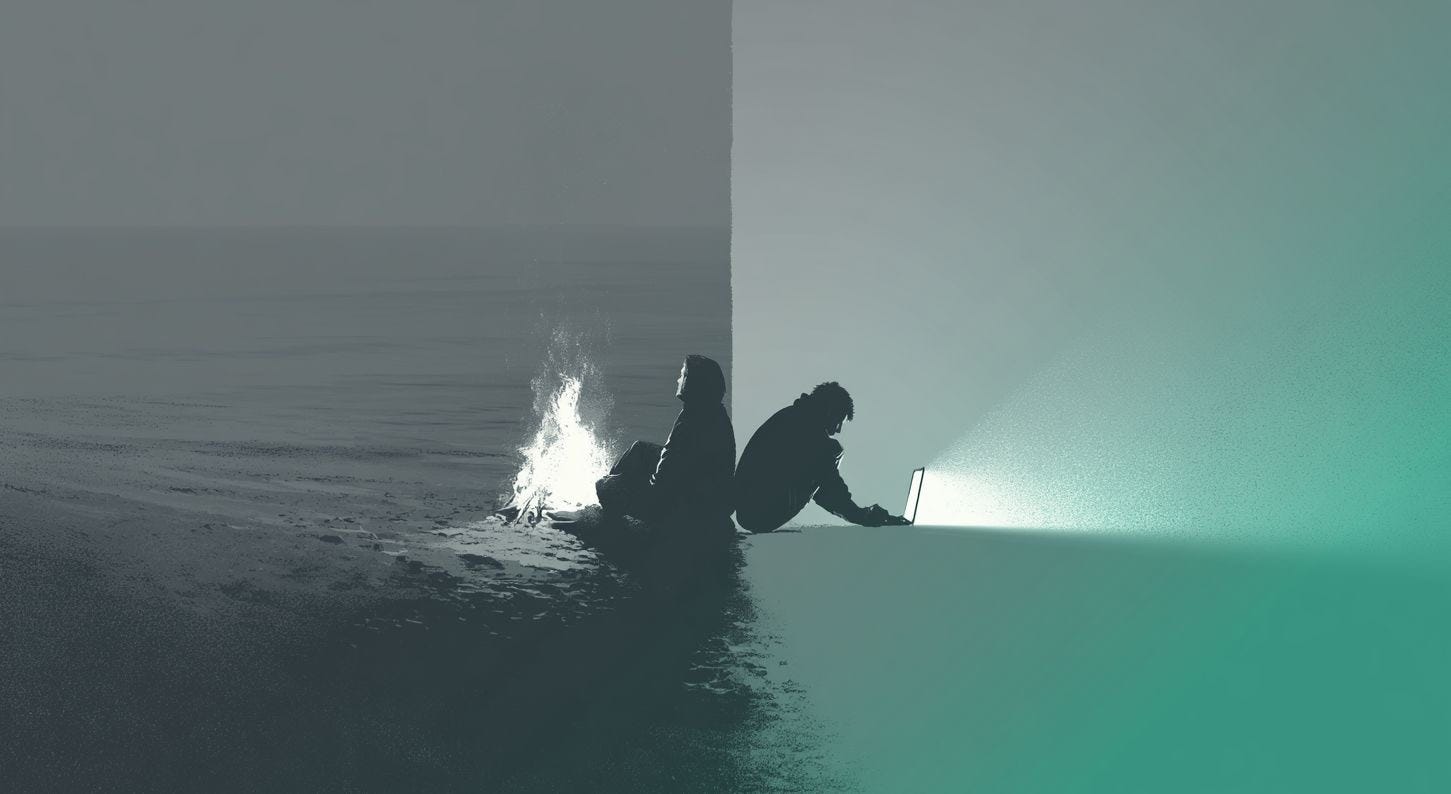
Some of the work you’ll do this week is going to be a waste of time. Some of the hardest work you'll do this week won't count as work to anyone.
That's not your fault. The issue is something you have come to accept without questioning it: the definition of work.
If you've ever felt empty after a ‘productive’ day full of meetings, guilty for an ‘unproductive’ day out in nature, or slightly ashamed when you said ‘I’m not working’ whilst you spent all day taking care of your baby, this essay is for you. And don't worry, I won't tell you to quit your job and go travel to South America. I'll leave you with something more useful.
What is work, really?
Work is not a job, even though we typically use these terms interchangeably:
‘I gotta go to work.
I’m late for work.
I’m out of work.
Now, I’m looking for work.’
A job is a much narrower idea: an exchange of time and effort for money.
It’s also a recent idea. The modern job emerged sometime in eighteenth-century Europe with the rise of factories (the first places to house industrial machinery).
Artisans who had previously worked from home began clocking in and out. The daily grind was born. And it really was daily then, as it took about another two hundred years before the emergence of the two-day weekend, and people finally joyfully declared: ‘Thank God it’s Friday!’
Even your hard-earned paycheck, which you spend on the weekend, is simply an idea that emerged at some point. There was a point in human history when money did not exist. Did people show up to work then? Of course they did. It’s hard to imagine hunter-gatherers going on strike.
‘Listen, man, I know we gotta light this fire, and hunt for this food, but I won’t do it until you pay me. And I want better working hours too. No more overtime!’
In an age before money, people still worked to ensure their own survival and the community's flourishing. It was work based on reciprocity, trust, and shared purpose.
The power of money lies in how it extends the circle of collaboration far beyond the people you care about. It is no longer the people in your immediate circle or your tribe who drive your efforts. Your efforts are now guided by the interconnected web of ‘I-owe-yous’ we call cash.
Money also allows us to specialise. It makes work more effective. I wouldn't know how to build the laptop I’m writing on, but I indirectly paid many others, each focused on a specific aspect, to do it for me. We thus get more laptops at a lower cost. Especially compared to a scenario where I build the laptop all by myself!
Yet even today, in a world dominated by money, we work without pay. Within the family, we take care of our children, our elderly parents, and the household chores - what we call ‘care work’.
So, work is neither a job nor a paycheck.
Work is any effort applied to a purpose, paid or unpaid, caring or not.
It is not only what you do to earn a living or to take care of your family, but also going to the gym to be healthy; it’s comforting your friend when they need you.
What then isn’t work? All that lacks either effort or purpose. Effort without purpose is a waste of time.
The definition may be very broad, but it forces the question of which of your efforts actually have purpose.
Keep this in mind, and you close your laptop without guilt after you finish the deliverable that actually moves the needle, instead of completing yet another task that doesn't. That hike in nature now counts as work too. A full day taking care of your child, rocking them to sleep in your arms, becomes one to feel proud of.
But before you close your laptop now, write down the five biggest efforts you anticipate this week - activities that require mental or physical energy and time - and next to each, their purpose. And if you can't, reconsider why you're doing it. Those activities are prime candidates for wasted effort.
On the other hand, some things on there you may not have considered work at all, but if they serve a purpose, then they sure are.
Now, with that, it's time to get to work.
Really enjoyed this read! So thought provoking and also appreciated the humour in it 😊
Excellent food for thought! What is currently unpaid work is what actually allows most families and communities to function!