


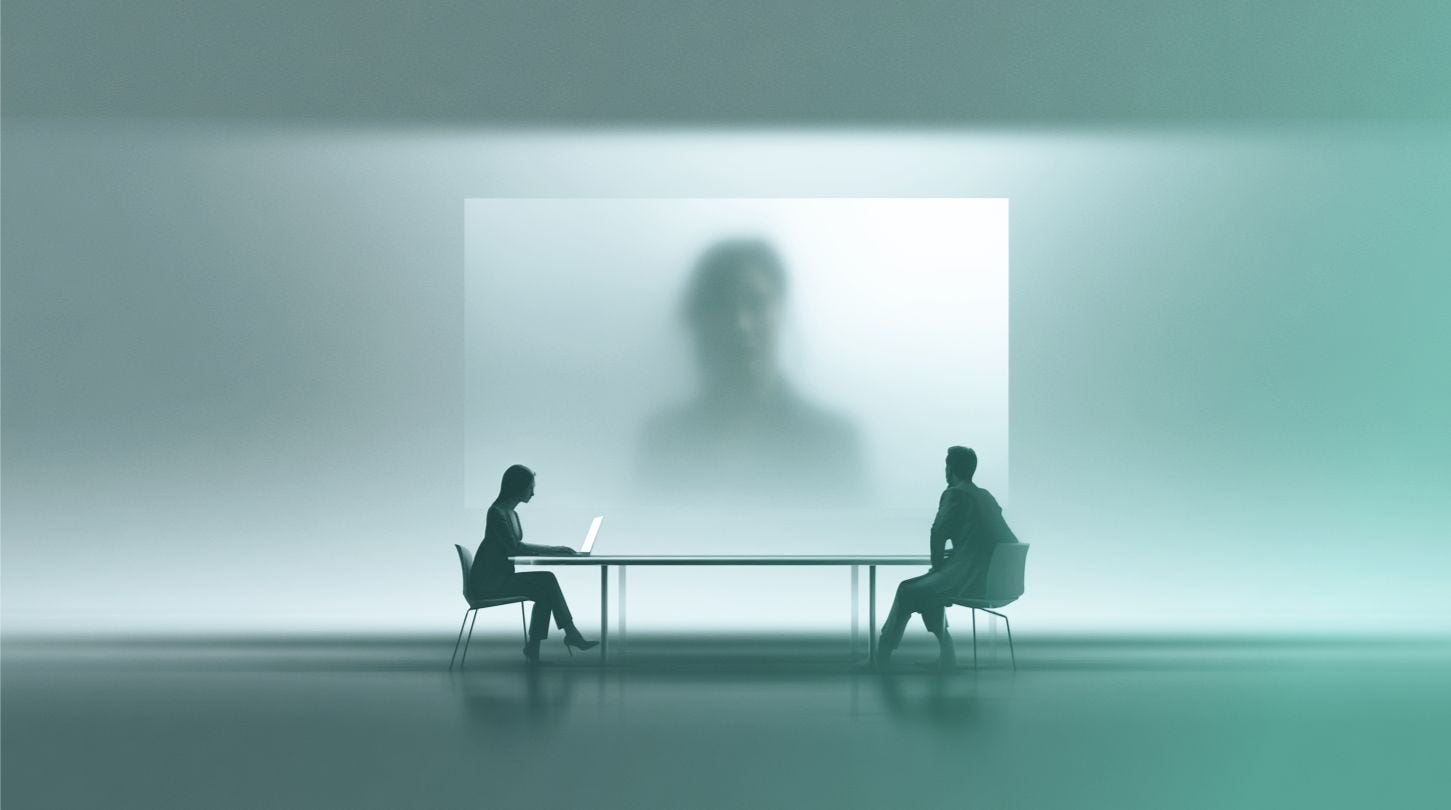
When I was a child, my father would always remind me to look others in the eye when talking to them. It’s a show of respect and common decency to acknowledge others by meeting their gaze, eye to eye, he’d say. I was a shy kid, so, to my annoyance, I was frequently called out for failing to do so in public social encounters. He was right, of course, and I learned my lesson; most people have. Then I entered the workplace and noticed that eye contact is becoming increasingly rare.
Have you ever tried making eye contact with someone on a web call? It’s pretty difficult. First of all, you can barely make out their eyes - small and pixelated on a screen. That is, if you’re even trying in the first place. If you’re anything like me, your attention will be tested as email and chat notifications pop up while your colleague is giving that presentation. They fight for your attention amongst a grid of other virtual avatars - including a mirror image of yourself (hmmm … is my hair looking ok?) - and most likely some PowerPoint slide at the fore.
But even if you withstand the frequent distractions, hearing another person’s words is not the same as hearing what they truly mean. Most communication is nonverbal and conveyed through our eyes, gestures, and body language. We miss out on all that when we only communicate via screens.
And it’s not just web calls. There are, of course, ‘hybrid’ meetings, meaning you’ll be in a room full of people, all not looking at each other, but at an oversized television screen prominently placed at the centre of the room. The virtual head of the table commands your focus. Invariably, the glaring lights of digital avatars compel your attention so much more easily than the real-life colleague sitting next to you - even when you speak, you face away from the faces physically there.
When you’re not in a meeting, sitting at your open floor desk (‘designed to facilitate collaboration’) is not much different. Others surround you; the room is full of people, bodies, faces. Yet where do you look and where do you place your attention? Of course, it’s squarely ahead, not left, not right - blinders on - there’s a screen in front of you.
Time for a well-deserved coffee break - at the kiosk of your office coffee shop, however, you’re yet again greeted by a screen. ‘Thank you for shopping with us - please select your payment method …’ You check your phone as the barista prepares your order. ‘Order number 63?’ Thank you, and back to work - no more conversations by the water cooler. The next virtual agenda item awaits.
If you work in any office job, you at least recognise what I just described. Screen-free moments are becoming increasingly rare.
We tend to be very aware of the distracting allure of screens in our personal lives. Who doesn’t feel at least somewhat addicted to their phones? And we take steps to limit our screen time outside of work. No phones before sleep. No phones at the dinner table. A more mindful life without the mesmerising glare of the digital realm. Why not apply the same wisdom to our working lives?
We talk about the ill effects of screens for children, cognisant of the importance of real-life social interactions in developing healthy social skills. Calls to ban or limit phones at schools are becoming more commonplace, driven by evidence that the iPhone generation, which Jonathan Haidt calls the anxious generation, is more distracted, indeed more anxious, and more divorced from the physical world than any before. But why wouldn’t what’s harmful for the younger generation be harmful for us too?
If we heed the wisdom we already apply in our personal lives and try to teach the younger generation, consider the radical idea that minimising screen time makes us more effective, even happier, at work.
Face-to-face human interaction - looking others in the eye, reading their body language, feeling their physical presence in three-dimensional space - is a basic requirement for fruitful communication.
The crux of the issue is that using screens merely gives us the illusion of human interaction. A virtual meeting is a useful tool, but substantively not very different from an old-fashioned phone call. Yes, virtual work means we can collaborate with teams across borders and work flexibly from home - real benefits worth preserving. But it’s no substitute for presence.
When cognitive work becomes increasingly automated, effective teamwork becomes the defining competitive advantage. Teams that replace the illusion of effective communication with real, robust conversations will outrun those that don’t.
Of course, so much of the output of modern work is increasingly digital - slide decks, spreadsheets, emails, tickets resolved, lines of code. And don’t get me wrong, screens and computers are awesome tools. The point is not to reject these tools, but to use them wisely and intentionally.
If we prioritise real conversations over digital ones, our digital work can flourish as well. Deep work becomes possible only when we go on ‘do not disturb’ and focus on a specific task, not while typing during a virtual meeting. So setting a structure around when to use screens, rather than using them for everything, all the time, and all at once, is a step in the right direction.
Reversing the screen saturation trend, back towards a more socially connected workplace based on physical, face-to-face interactions, is no easy task. The only way to achieve it is a greater collective acceptance of screen-free work. It could be running important meetings without any laptops. Or smaller efforts, like making a point of looking at the speaker in the room rather than at the big screen, which invariably pulls your attention. Like being online, being offline has its own network effect. You cannot do it alone.
Wow, what a great read! Resonated with my experience in the work place and how it can sometimes take courage to look people in the eye when you’re back to working in person. Also enjoyed the connection to your childhood in the beginning !
Eye contact is a skill that requires practice. It’s the first step towards being vulnerable towards another human and having a genuine exchange. Your dad was a wise man - I hope there are more fathers like him out there to guide the next generation through the jungle of screens!